
Bambaragala, Theldeniya, Sri Lanka.
The birth place of the Buddha.

Hiriwadunna, Habarana, Sri Lanka..
The place of enlightenment of the Buddha.

Isinbessagala, Madawachchiya, Sri Lanka.
The place of the first sermon of the Buddha.

Budugala, Balangoda, Sri Lanka.
The place of Parinibbana (passing away) of the Buddha.
Showing posts with label ශිලා ලේඛනයන්ගෙන් හෙළිවන හෙළ බුදු උරුමය (The Buddhist heritage hidden in the inscriptions). Show all posts
Showing posts with label ශිලා ලේඛනයන්ගෙන් හෙළිවන හෙළ බුදු උරුමය (The Buddhist heritage hidden in the inscriptions). Show all posts




King Panitha who reigned in Helabima or Sri Lanka in Buddha's time


1035 {(.. the cave)
of Panihitha treasurer of the great king and..}
(Sinhala
Shilalekhana Sangrahaya, Page 166)
What is mentioned above is the
inscription which talks about this particular king and it the Sinhala
translation of Professor Nandaseana Mudiyanse. It can be very clearly seen that
Professor Senarath Paranavithana had changed the meaning of this inscription,
in the process of the interpretation. Now, let's look in to the view point of
the Archeological Department as well which was the cause of this
interpretation. For that, it is
necessary to look in to the original inscription.

(The cave) of the chief Sumana,
officer in charge of the store-house of goods in deposit, of the great king
(I.C. 81)
The act of presenting the name of
the great king 'Panita' as Pranihitha and also with an adjective to 'store-house
in goods deposits' can be explained as a modification done for this
inscription. Because of this, the name which could be used to recognize the
great king reigned in Buddha's time was lost.
There is a statement describing
this king in Pāli Balawatharaya written by Venerable Hikkaduwe Sri
Sumangala Maha Nayaka Thero in 1882. This book reports that a branch of the sacred Sri Maha Bodhi tree, in
the time of the Buddha, had been taken in procession by a Bhikkuni called Shona
and it had been planted by the great king Panitha at the Shakya Wansha Vihara.
Mahavamsa, the great chronicle,
too states that branches of the sacred Bodhi tree had been planted by the
respective kings living in the times of Kakusanda Buddha, Konagama Buddha and
Kshyapa Buddha.Not only that, this had been taken in to the Dasamara Piritha in
the Pirith Book as well. But, planting of a sacred Bodhi tree in this manner is
not stated in Mahavamsa and Dasamara Piritha.
There is an inscription stating
the kingship in Heladeepa. But that inscription does not carry any name. This
inscription is found in the area of Mihinthale.

(The cave of Mahanbika,
the daughter of Dweeparaaja, is (given for) Sanga )
(Sinhala Shilalekhana Sangrahaya,
Page 53)
Let's identify the name of the
father, the king, of the daughter Mahabiya.
There is another inscription
which is evident for this King Deepa to be a Maha Raja ( a great king).This can
be proved by the inscription at the Korathota Vihara.

1103. (The cave of Mahabiya, (who is) the daughter of the great
king, was given for the Sangas who did come and did not come from all four
directions).
(Sinhala Shilalekhana Sangrahaya,
1103)

King Panitha can be identified well through the inscriptions
found from many inscriptions in Sri Lanka. The authors of Indian influence such
as the one of Mahavamsa did their best to destroy the history of Lanka. On key archeologist
got the opportunity to bring light to chase out that darkness through the
inscription, but he also did the same. Even to this date, it is visible that
the students of that master are committed to safe guard the betterment of their
teachers, but not the glory of the motherland, Sri Lanka.

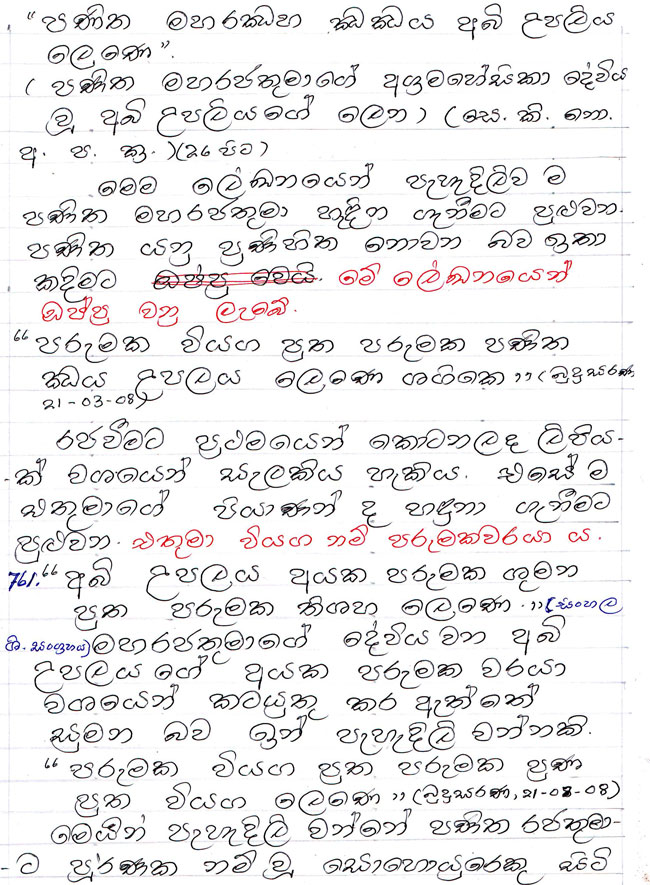
(The cave of Abi
Upaliya, who is the Chief Queen of the Great King Panitha)
(Sellipi Kiyaweemata Nohaki Apata
Pahasu Kramayak, Page 26)
This inscription can be used to
positively to identify King Panitha. This inscription proves, very positively,
that Panitha is not Pranahitha.

This inscription can be considered as something did before he become
the king. And his father also can be identified. HIs is a Parumaka called
Viyaga.

Sumana had worked as the Ayaka parumaka of Abi Upalaya, the
queen of the great king.

According to this inscription Nagasha was another brother of
King Panitha. This inscription says that this brother of King Panitha called
Nagasha had done an offering to the Buddha and the noble Sanga. " Aparimitha Lokadathushe" is a term used for the
Lord Buddha.
" Aparimitha Lokadathushe" is a term used for the
Lord Buddha.
 " Aparimitha Lokadathushe" is a term used for the
Lord Buddha.
" Aparimitha Lokadathushe" is a term used for the
Lord Buddha.
It's a chief called Pussadewa had
worked as the Ayaka Parumaka of Panitha Maha Raja. This is mentioned in an
inscription situated in Akurugodella in Sithulpawwa. That inscription is as
follows.

A Parumaka called Sumana had
worked as the treasurer for the Greta King Panitha. The term such as  is attached to the name of Sumana , to introducing his name,
to describe his relationship as a son of King Panitha. The inscription for that is as follows.
is attached to the name of Sumana , to introducing his name,
to describe his relationship as a son of King Panitha. The inscription for that is as follows.
 is attached to the name of Sumana , to introducing his name,
to describe his relationship as a son of King Panitha. The inscription for that is as follows.
is attached to the name of Sumana , to introducing his name,
to describe his relationship as a son of King Panitha. The inscription for that is as follows.
The father-king mentioned here can be identified as King
Panitha and Sumana is the noble person called God Sumana Saman. The term called
Bagawatha found in this inscription is used for Buddha and it suggests that the
period of this inscription can be taken as of Buddha's time. The inscription
found in Bana Samanala confirms this further. The inscription found at the
Samanala Peak is as follows.

A Parumaka called Damaraja had worked in the process of making
the steps of the sacred footprint of the Buddha at Sri Pada Peak. That is why
it is called Darmarajagala ( the peak or the mountain of Darmaraja) It can be
seen in the inscription at Bowaththegala. The inscription numbered as 549 is an
evidence for it. The name called Shumana found in this inscription has been
changed as Gamana by the Archeological Department, but it can be seen as it is
in the picture of its block (platelix). Finally, this proves that Parumaka
Sumana is no one else, but God Sumana Saman.
Although the name of the great
King Panitha has been removed from the texts\books, the letters engraved on the
rock stand on the place where the noble person called King Panitha had reigned
in Lanka in the time of Buddha. The Great King Panitha was the owner of the
biggest shipping company in Lanka. The commander of it was a Parumaka King Gōtabhaya.
After the death of the great King Panitha, King Gōtabhaya got all the
possessions of the shipping company under his commands and was popular as
Pugiyana (Shipping company) ( 662. Madukashaliya Pugiyana Lene Shagasha. Professor Senarath Paranavithana had
disappeared the picture plate of this inscription. It is understandable that driven
by the intention that the world will know about this, he must have acted in
this cheap manner. This teaches a very good lesion to all who have the interest
in destroying the glory of the motherland.
The list of the books refered by
Mookalangamuwe Pannananda
- Nethadutude
- Panitha Rajathuma ( Manuscript)
- Budhusarana ( 2008.02.20, 2008.03.21)
- Lanka Shilalekhana Sangrahaya 01
- Sinhala Shilalekhana Sangrahaya 01
- Sellipi Kiyaweemata Nohaki Apata Pahasu Kramayak

What is the hidden history behind The Cave Vihara in Hennaanigala
What is the hidden history behind The Cave Vihara in Hennaanigala
 |
Hennaanigla
Cave Temple, Mahaoya, Sri Lanka
|
This
unique colossal rock which resembles with the 8th wonder in the
world Sigiriya is situated within the Maduruoya National Park nearly 9 Kms from
the Mahaoya junction on Maoya - Arannaganvila road. This historical place is
considered as the location where the troops of the Great King Gamini Abaya
(King Dutugamunu, as chronicles name him) had been gathered. In the past, this
place had been known as Hennanegala, so it' only little changed had been added
to the name.
According
to Mr. C. W. Nicholas, the author of "Historical topography of Ancient and
Medieval Ceylon" describes this place as the biggest cave, engraved with
Kataram, found in Sri Lanka. But, he had
failed to highlight the significance of the place. According to a rock letter,
there had a been a city called Kasaba Nagara and few some other villages, namely,
Giritishagama, Karajinitishagama and Vilagama. "Nokapike" found in
the inscription had not been declared as a village by Mr. Nicholas, but Mr. Mudiyanse
had done so. There are two special symbols found in the inscription, the symbol
of the kingdom and the other is a symbol of a fish.
The
inscription is as follows.

A particular
dynasty called Meenaasi which is not documented in the chronicles is indicated in
Varigapoornika. Vargapoornika discloses a true history in Heladiva (Sri Lanka)
which is not taken in to notice by the chronicles. These two symbols can be
seen in many other inscriptions as well.
According
to the inscriptions, Sumana who lived in the period of the Buddha had
connections with the lineage found here. The inscriptions which have
connections with Sumana, Damaraja, Mahatishaaya and Abisawera too carry these
two symbols. 'Abisawera' mentioned here is Queen Viharamahadevi, the mother
Queen of Great King Gamini Abaya. The archeologists say that this is the
lineage of the Queen Viharamahadevi.
Above
mentioned inscription reveals the fact that a pooja (an offering or a
declaration) of cities and villages had been occurred by two ruling systems.
Hence, the villages which carry the name of Tissa may be ruled by the father of
Gamini Tissa. Other villages and the city may come under the ruling of the king
in the central region.
There
are several reasons to support this pooja as something special. This pooja
had been done as a public pooja and based on the way of Buddhist, a
relationship to the time of Buddha can be seen here. A special name of an individual
cannot be seen, instead a collective name had been mentioned in the pooja.
There is a probability where the father of Gamini Tissa can be named as Tissa
as well. Hence, this inscription is evident for a poojaa (an offering of
food and other essentials) made by the ones in the generation bearing the
family name Tissa and also the people of the king of the central region for the
Darmasena (the army\troops of Dhamma or the crowd of the great Bhikkus) who
gathered to this Hennaanigala.
In
getting a precise understanding over the Darmasena gathered at Hennaanigala, it
is necessary to go for an interpretation of the ancient name used for this
place. The term "Nokapika" places an important role here. This cannot be a name of a village. "Alms
giving and other things were done continuously as Kapasaru" is the meaning
of it.
 |
| Hennaanigla
Cave Temple, Mahaoya, Sri Lanka ( Line of chambers\rooms built (presently
destroyed ) against the wall of the colossal rock. " Hennanegala (fykAkfkA., - fy kA k fkA . , ) " |
In understanding
the truth of the hidden history disclosed by this term, it is a must to interpret
this appellation.
It should be explained from y + w (Ha+A) to y + M (Ha+Ē). The formula goes as
follows.
y + w, y+ wd, y + we, y + wE, y + b, y + B, y + W, y + W! and y + t.
According to this formula y + t comes as fy (He - as in Hennanega). Now, let's take these separately and
understand the meaning of the word fy
(He).
In the Magadhi appellation code, fy (He) is used
for Jaathi (the birth or coming in to being). Following the seeds of Kamma, a
birth will be occurred from the Ninth sphere,is the meaning of this. For this
birth a Nine will be joined with another Nine.
Hence, Nice will come in and be united as two
forms - internal and external. Apo, Thejo, Vayo, Pathavi, Varna, Ghanda, Rasa, Oja
are those externals in Nine. Rupa, Vedana, Sanna, Sankhara, Vinna, Naamarupa,
Salayathana, Bhava and Jathi are the internals of this Nine. Here, in this
process, the birth occurred by being united by two folds of Nine, becomes a
Nine. This joining of Nine to Nine which depicts this birth is explained by "kk" (Nana).
The next letter, k, is
used as k + ta. This
formation of fka (Ne) will come under the tenth sphere and
that is Jara (aging). The existence of Samsara (the circle of re-becoming of life)
can be understood when it explained on the platform of Jara and Marana (Decaying
and death). In this manner, it can be observed well the circle of Samsara - its
crashing off, embracing in to it, experiencing its continuity.
 |
| Chaithya or Dagabo at Hennanigala cave Vihara, Sri Lanka |
 |
The
remaining frescoes of Hennaanigla Cave Temple, Mahaoya, Sri Lanka ( If no any
actions to protect these priceless paintings are taken,it is certain that
they will vanish off within the very near future)
|
හෙන්නානිගල ධර්මථාව කුමක්ද?
හෙන්නානිගල ධර්මථාව කුමක්ද?
 |
| Hennaanigla Cave Temple, Mahaoya, Sri Lanka |
 |
| Hennaanigla Cave Temple, Mahaoya, Sri Lanka ( Line of chambers\rooms built (presently destroyed ) against the wall of the colossal rock. |


 |
| The remaining frescoes of Hennaanigla Cave Temple, Mahaoya, Sri Lanka ( If no any actions to protect these priceless paintings are taken,it is certain that they will vanish off with the very near future) |
 | |
|
 | |
|
Subscribe to:
Posts (Atom)


