
Bambaragala, Theldeniya, Sri Lanka.
The birth place of the Buddha.

Hiriwadunna, Habarana, Sri Lanka..
The place of enlightenment of the Buddha.

Isinbessagala, Madawachchiya, Sri Lanka.
The place of the first sermon of the Buddha.

Budugala, Balangoda, Sri Lanka.
The place of Parinibbana (passing away) of the Buddha.


Dambadiva (Dabadiva) is Heladeepa and it is not India

There
is an acceptable proof in the sacred book Poojavaliya (Pōjāvaliya) which can be
used to 'take out' the act of using Dambadiva in the place of India. This book
was written in Sri Lanka in between 1266-1275 years by Buddha Puthra of the
Parivenadipathi[3] of Mayurapada Pirivena[4]
who lived in the reign of the Great King Pundit Mahan Parakramabahu. In this
sacred book Nepal, Kambodia (Kāmboja) and the country called Lata (Lāta) are considered
as lands where Buddhas are not born (Pōjāwaliya, Page 108).Following this particular description in this
book, the belief that the Buddha was born in Nepal can be proved as false.
 |
| Poojavaliya - The cover of the book |
 |
| Poojavaliya - Page 108 and 109 |
The Buddhist clergies who are powerful and influential,
who organize, administer and advice the 'gangs of pilgrims' to India are not
interested in this truth which was indicated in Pōjāwaliya. They are totally against this story found in
this sacred book. Both these parties do not want, at all, to lose the great financial
gains they could enjoy by organizing trips for these groups to India. They use
media very effectively to work and talk against the books written on the subject
that Buddha was born in Lanka. That is not because of their respect and love
for The Enlightened One, but because they have experienced the financial gains
and recognition and do not want to lose them.
Anyone who is aware of the language[5]
will positively confirm that the term 'Dambadiva' is a heritage of Lanka and it
does not, in any way, suit with the country called India. Hence, it is evident
that they act in that manner, though it is well visible and understandable, not
because of anything else but because of the reasons stated above.
Another classic example to present for this is Rasavahiniya
(Rasavāhiniya), another book written in Lanka. The stories in this book discuss
about Lankadeepa ( Lankādeepa) and Jambudeepa. These stories discuss the
incidents related to the two main regions, Lankadeepa and Jambudeepa, situated
in Heladeepa and they do not discuss anything related to India in any manner.
Even though the facts do stand in that manner, due to the
statements of jabbering and false views made by 'the scholars with far sighted
thinking' a strange India has come in to the scene. This gang of sinful Brahmins
living in Lanka, though they are born in this blissful land, they have not
identified it and have done their best to condemn the significance and the
value of Sri Lanka. And also, now it can be seen in newspapers and in
television media that they are fully equipped and 'charged' themselves and
awaiting for a battle.
Not only that. So called great translators and
interpreters had shown their talents by fully changing the names of the people
and villages seen by the Englishmen with new names and titles. It is also, of course,
not rare to see the sinful pundits who do admire the acts of these translators
and interpreters.
" … and for this purpose requested a conference might
take place in Dambadiva, about fifty - seven miles east of Colombo…." ( Ceylon and the Cingalese, Page
301,302,303).

The word Dambadiva found in this book written in English language had been translated in to Sinhala language as 'Lankava and Sinhalayo' by a gentleman called Mr. Premachandra Alwis and had translated it as Dambadeniya[6]. Hasn't he done this with the intention of destroying the great honor that Sri Lanka could have enjoyed as Punyabhoomi ? ( Page 192)
 Colombo or Kolomthota[7]was
situated within the vicinity of Dambadiva. A statement stands on the truth of
this is found in Rajavaliya (Rājāvaliya) is as follows.

The word Dambadiva found in this book written in English language had been translated in to Sinhala language as 'Lankava and Sinhalayo' by a gentleman called Mr. Premachandra Alwis and had translated it as Dambadeniya[6]. Hasn't he done this with the intention of destroying the great honor that Sri Lanka could have enjoyed as Punyabhoomi ? ( Page 192)

 |
| The front cover of Rajavaliya |
" …that day a ship from the land of Portugese in
Janbudweepa in the year of our Lord Jesus Christ of one thousand five hundred
and twenty two sailed with all of mighty powers in the middle of the great
oceans without any calamities and anchored in the port in Kolomthota and … " (Rajavaliya, Page 12).
 |
| Page 12 of Rajavaliya which explains "...that day a ship from the land of Portugese...." |
In this extract, there are two parts, namely, the main
sentence and the inter sentence or the sub sentence. A full understanding can
be taken by re-writing this as two different sections. Someone who is aware of
this way of writing, this is of course will not be an issue. But, someone who
is not aware of this style in grammar may get confused to understand this particular
sentence.
The main sentence in this is as follows.
"…
that day when (the ship) anchored in the port in Kolomthota…". This is the main sentence. The rest of the
statement is the inter sentence. Having separated in to two parts and explained
the grammatical methodology hidden in this sentence, other than the 'pundits'
mentioned above, any other person will be able to easily understand it. The
oldest monastery situated in Colombo was Kaladighavapidvara Vihara (Kāladeeghavāpidv ra Vihāra). Today it has become a court complex[8].
This is another place where it had lost its Buddhist heritage due to the
invasions of the Portuguese.
ra Vihāra). Today it has become a court complex[8].
This is another place where it had lost its Buddhist heritage due to the
invasions of the Portuguese.
In another place it is mentioned as follows.
" … in Dambadiva in whole of Jambudweepa that day a ship from the land of Portugese in the year of our Lord Jesus Christ of one thousand five hundred and twenty two sailed with all of mighty powers in the middle of the great oceans without any calamities and anchored in the port in Kolomthota and … " (Rajavaliya, Page 13).
" … in Dambadiva in whole of Jambudweepa that day a ship from the land of Portugese in the year of our Lord Jesus Christ of one thousand five hundred and twenty two sailed with all of mighty powers in the middle of the great oceans without any calamities and anchored in the port in Kolomthota and … " (Rajavaliya, Page 13).
 |
| Page 13 of Rajavaliya which describes "… in Dambadiva in whole of Jambudweepa that day ..." In order to understand this too, it is necessary to take out the sub sentence found in the statement and isolate the main sentence. |
"… in Dambadiva in whole of Jambudweepa and anchored
in the port in Kolomthota and …" gives the exact meaning of this sentence.
1. Landing
Kolomthota was done by whom? They are the Portuguese.
2. Where
did they come from? They came from
Portugal.
3. Where
was Kolomthota situated? It was situated in Jambudweepa.
"Dambadiva was situated in the east, 57 miles from
Colombo" - 'Ceylon and the Cingalese' the book written by
Mr. Henry Charles Sirr, explains.
It is then understood that there had been two main
regions in Heladeepa, namely, Lakdiva[9]
and Dambadiva. Because of this split of the regions only it says that Gauthama
Buddha had come to Lakdiva from Dambadiva. As it was failed to understand this in
advance, we had to stand with the offence of presenting Dambadiva as a land
which has connections with India.
[1] The Sacred Land.
[2] The Land of the Buddha.
[3] The chief
incumbent of a Pirivena.
[4] The
training monastery for Bhikkus i.e. the Buddhist monks
[5] Sinhalese,
the language of the Sinhala people.
[6] Another
town in Sri Lanka.
[7]
The harbor of Colombo.
[8]The
supreme court complex in Halsdorf in Colombo.


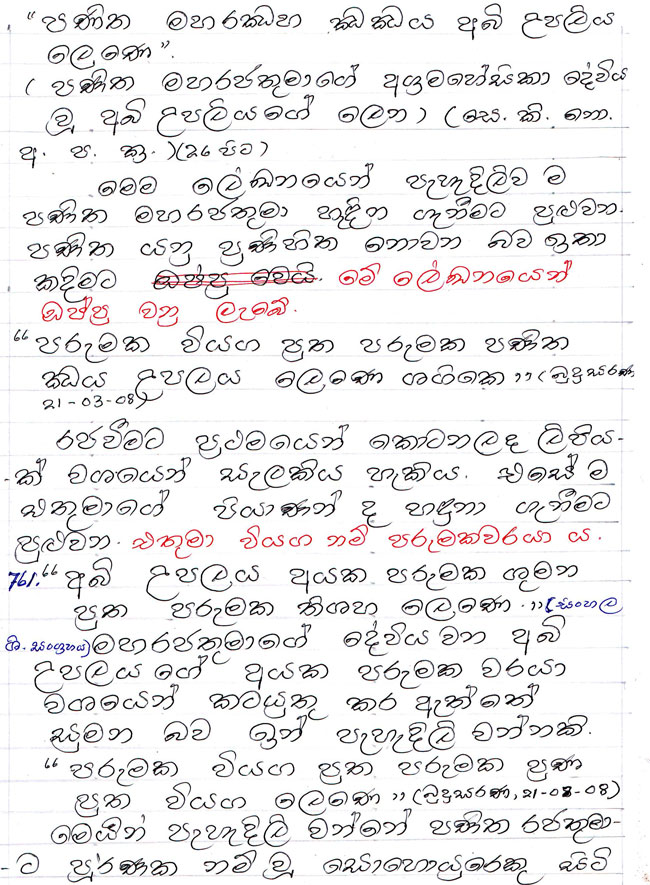


King Panitha who reigned in Helabima or Sri Lanka in Buddha's time


1035 {(.. the cave)
of Panihitha treasurer of the great king and..}
(Sinhala
Shilalekhana Sangrahaya, Page 166)
What is mentioned above is the
inscription which talks about this particular king and it the Sinhala
translation of Professor Nandaseana Mudiyanse. It can be very clearly seen that
Professor Senarath Paranavithana had changed the meaning of this inscription,
in the process of the interpretation. Now, let's look in to the view point of
the Archeological Department as well which was the cause of this
interpretation. For that, it is
necessary to look in to the original inscription.

(The cave) of the chief Sumana,
officer in charge of the store-house of goods in deposit, of the great king
(I.C. 81)
The act of presenting the name of
the great king 'Panita' as Pranihitha and also with an adjective to 'store-house
in goods deposits' can be explained as a modification done for this
inscription. Because of this, the name which could be used to recognize the
great king reigned in Buddha's time was lost.
There is a statement describing
this king in Pāli Balawatharaya written by Venerable Hikkaduwe Sri
Sumangala Maha Nayaka Thero in 1882. This book reports that a branch of the sacred Sri Maha Bodhi tree, in
the time of the Buddha, had been taken in procession by a Bhikkuni called Shona
and it had been planted by the great king Panitha at the Shakya Wansha Vihara.
Mahavamsa, the great chronicle,
too states that branches of the sacred Bodhi tree had been planted by the
respective kings living in the times of Kakusanda Buddha, Konagama Buddha and
Kshyapa Buddha.Not only that, this had been taken in to the Dasamara Piritha in
the Pirith Book as well. But, planting of a sacred Bodhi tree in this manner is
not stated in Mahavamsa and Dasamara Piritha.
There is an inscription stating
the kingship in Heladeepa. But that inscription does not carry any name. This
inscription is found in the area of Mihinthale.

(The cave of Mahanbika,
the daughter of Dweeparaaja, is (given for) Sanga )
(Sinhala Shilalekhana Sangrahaya,
Page 53)
Let's identify the name of the
father, the king, of the daughter Mahabiya.
There is another inscription
which is evident for this King Deepa to be a Maha Raja ( a great king).This can
be proved by the inscription at the Korathota Vihara.

1103. (The cave of Mahabiya, (who is) the daughter of the great
king, was given for the Sangas who did come and did not come from all four
directions).
(Sinhala Shilalekhana Sangrahaya,
1103)

King Panitha can be identified well through the inscriptions
found from many inscriptions in Sri Lanka. The authors of Indian influence such
as the one of Mahavamsa did their best to destroy the history of Lanka. On key archeologist
got the opportunity to bring light to chase out that darkness through the
inscription, but he also did the same. Even to this date, it is visible that
the students of that master are committed to safe guard the betterment of their
teachers, but not the glory of the motherland, Sri Lanka.

(The cave of Abi
Upaliya, who is the Chief Queen of the Great King Panitha)
(Sellipi Kiyaweemata Nohaki Apata
Pahasu Kramayak, Page 26)
This inscription can be used to
positively to identify King Panitha. This inscription proves, very positively,
that Panitha is not Pranahitha.

This inscription can be considered as something did before he become
the king. And his father also can be identified. HIs is a Parumaka called
Viyaga.

Sumana had worked as the Ayaka parumaka of Abi Upalaya, the
queen of the great king.

According to this inscription Nagasha was another brother of
King Panitha. This inscription says that this brother of King Panitha called
Nagasha had done an offering to the Buddha and the noble Sanga. " Aparimitha Lokadathushe" is a term used for the
Lord Buddha.
 " Aparimitha Lokadathushe" is a term used for the
Lord Buddha.
It's a chief called Pussadewa had
worked as the Ayaka Parumaka of Panitha Maha Raja. This is mentioned in an
inscription situated in Akurugodella in Sithulpawwa. That inscription is as
follows.

A Parumaka called Sumana had
worked as the treasurer for the Greta King Panitha. The term such as  is attached to the name of Sumana , to introducing his name,
to describe his relationship as a son of King Panitha. The inscription for that is as follows.
 is attached to the name of Sumana , to introducing his name,
to describe his relationship as a son of King Panitha. The inscription for that is as follows.

The father-king mentioned here can be identified as King
Panitha and Sumana is the noble person called God Sumana Saman. The term called
Bagawatha found in this inscription is used for Buddha and it suggests that the
period of this inscription can be taken as of Buddha's time. The inscription
found in Bana Samanala confirms this further. The inscription found at the
Samanala Peak is as follows.

A Parumaka called Damaraja had worked in the process of making
the steps of the sacred footprint of the Buddha at Sri Pada Peak. That is why
it is called Darmarajagala ( the peak or the mountain of Darmaraja) It can be
seen in the inscription at Bowaththegala. The inscription numbered as 549 is an
evidence for it. The name called Shumana found in this inscription has been
changed as Gamana by the Archeological Department, but it can be seen as it is
in the picture of its block (platelix). Finally, this proves that Parumaka
Sumana is no one else, but God Sumana Saman.
Although the name of the great
King Panitha has been removed from the texts\books, the letters engraved on the
rock stand on the place where the noble person called King Panitha had reigned
in Lanka in the time of Buddha. The Great King Panitha was the owner of the
biggest shipping company in Lanka. The commander of it was a Parumaka King Gōtabhaya.
After the death of the great King Panitha, King Gōtabhaya got all the
possessions of the shipping company under his commands and was popular as
Pugiyana (Shipping company) ( 662. Madukashaliya Pugiyana Lene Shagasha. Professor Senarath Paranavithana had
disappeared the picture plate of this inscription. It is understandable that driven
by the intention that the world will know about this, he must have acted in
this cheap manner. This teaches a very good lesion to all who have the interest
in destroying the glory of the motherland.
The list of the books refered by
Mookalangamuwe Pannananda
- Nethadutude
- Panitha Rajathuma ( Manuscript)
- Budhusarana ( 2008.02.20, 2008.03.21)
- Lanka Shilalekhana Sangrahaya 01
- Sinhala Shilalekhana Sangrahaya 01
- Sellipi Kiyaweemata Nohaki Apata Pahasu Kramayak
කලිඟු පුරවරය පිහිටියේ සිරිලකයි, ඉන්දියාවේ නොවේ. City of Kaalinga ( City of Kalinga) was situated in Heladiva (Sri Lanka), but not in India.
දේශීය පතපොතින් හෙළිවන හෙළ බුදු උරුමය - 16
(The Buddhist heritage hidden in the books written in Sri Lanka)
 |
| Credit -srilanka.for91days.com |
කලිඟු පුරවරය පිහිටියේ සිරිලකයි, ඉන්දියාවේ නොවේ.
City of Kaalinga ( City of Kalinga) was situated in Heladiva (Sri Lanka), but not in India.
The Englishmen included Solos
Maha Janapada (The Great Sixteen Cities) in the Indian history which was written
by them for India. One of these cities
is Kaalinga Nuwara or Kalingu Nuwara or The City of Kaalinga. But, this city can be identified within
Heladeepa, Sri Lanka…
Securing the knowledge, as well
as the heritage of people in Heladeepa had with Gauthama the Buddha was the objective
of writing the most ancient book, Poojaawaliya, facing lot of difficulties.
Following the path showed by Poojawaliya; including Kaalinha Nuwara, Kurunagala (Hasthipura) is the main 'key' to
identify other cities, also…
Danthapura (City of Dantha) in
Kalingurata (The city of Kaalingu or Kaalinga) was a name used in ancient times
in Heladeepa, Sri Lanka…
A king called Assaka had ruled a
city called Pothalie in the country (or the region) called Assaka. C W Nicholas
(Historical Topography of Ancient and Medieval Ceylon - Journal of the Ceylon
Branch of the Royal Asiatic Society) says that until the time that Sirilaka
(Sri Lanka) was defeated by the British, the name 'Pothalie' found in the
Jathaka Stories had used in Sirilaka. And also the inscriptions can be used to
prove that there had been a city called Assaka…. these inscriptions are found
near Dimbulagala. Hence the city of Kaalinga should be located somewhere near
Dimbulagala...
Mr Brohier explains lots of
information about this city called Kaalinga…. according to this information The
Sacred Tooth Relics of Buddha had been placed in this city. Names such as Prince
Dantha and Princess Hemamali have more connections with Sri Lanka… This is the secret
behind the fact that some of the kings ruled Helabima are coming under Kalinga
Clan (NIsshankamalla, Sahasamalla, Vijayabahu in Dambadeni). They are not
coming from a dynasty belongs to India but of another region in Lanka itself….
Translated by Amal
Meemanage (amalmeemanage@gmail.com)


Subscribe to:
Posts (Atom)


